
Let’s be honest — building a niche site in 2025 is a volume game. Google rewards websites that cover topics deeply and consistently. The problem? Writing 50, 100, or 500 articles is exhausting, expensive, and slow.
That’s where AI content automation changes everything. In this guide, you’ll learn how to use AI to build a niche site that actually ranks on Google — without spending hours writing every article yourself.
Let’s get into it.
Why Niche Sites Still Work in 2025
Despite what you may have heard, niche sites are far from dead. The sites that are struggling are the ones that publish thin, generic content. The ones winning? They’ve doubled down on depth, consistency, and topical authority.
Topical authority means covering an entire topic so thoroughly that Google sees your site as the go-to resource. Think of it like becoming the Wikipedia of your niche — but actually readable.
To build topical authority, you need:
- Lots of content covering related sub-topics
- Consistent publishing over time
- Well-structured, SEO-optimized articles
- Internal links connecting your content
The challenge for most site owners is doing all of that consistently. That’s the exact problem AI content tools solve.
Step 1: Pick a Tight Niche (This Is Critical)
Before any AI tool can help you rank, you need a clearly defined niche. Not “fitness” — that’s too broad. Think “resistance band workouts for people over 50” or “budget travel in Southeast Asia for solo women.”
A tight niche means:
- Less competition from giant authority sites
- Easier to achieve topical authority quickly
- More targeted traffic that actually converts
Use tools like Google’s autocomplete, Reddit, or Answer The Public to find what real people are searching for inside your niche. These long-tail queries are your goldmine.
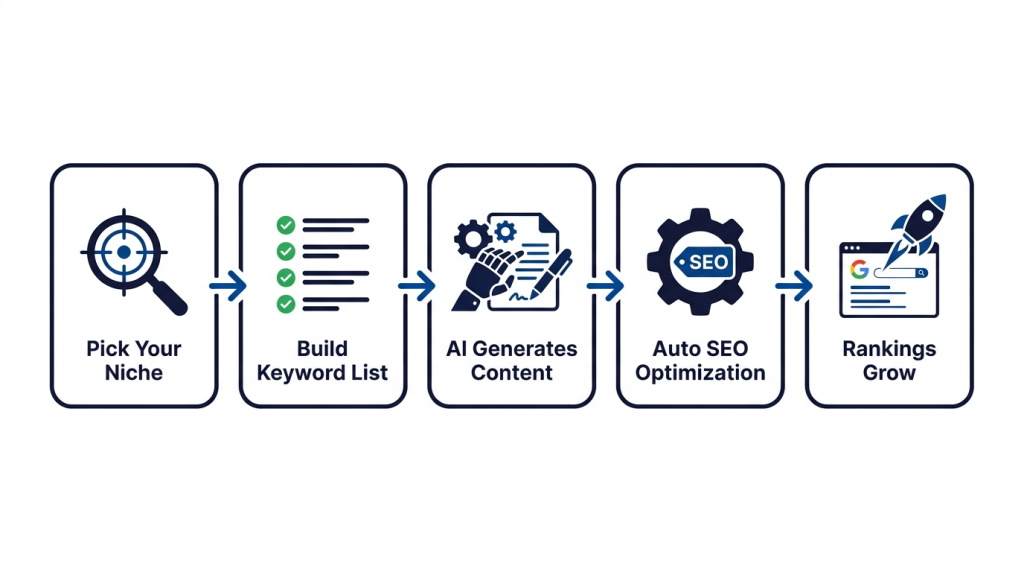
Step 2: Build a Keyword List (Let AI Do the Heavy Lifting)
Once you have your niche, you need a list of keywords — ideally 50 to 200 of them. These become the topics for your AI-generated articles.
Focus on:
- Long-tail keywords (3-5 words): Lower competition, higher conversion intent
- Informational queries: “how to,” “what is,” “best way to” — these rank well with content-focused sites
- Related sub-topics: Build clusters of content that link together
A solid content strategy looks like this: one main pillar article targeting a broad keyword, surrounded by 10-20 supporting articles targeting related long-tail terms. All of them interlink. This is a content cluster, and Google loves it.
Step 3: Use AI to Generate and Publish Articles at Scale
Here’s where most people get stuck. They know what to write — they just can’t do it fast enough. Writing one solid SEO article takes 2-4 hours. Writing 100 of them is a full-time job.
AI content tools like AutoContent AI change this completely. Instead of writing articles one by one, you feed in your keyword list and the system generates fully formatted, SEO-optimized posts — and publishes them directly to your WordPress or Shopify site on a schedule.
Here’s what that workflow looks like in practice:
- Install the plugin on your WordPress site
- Upload your keyword list
- Set your publishing schedule (daily, weekly, or bulk)
- The AI writes, formats, and publishes each post automatically
- You check the activity log and monitor traffic growth
That’s it. Your blog runs itself. Instead of spending your time writing, you spend it on strategy — picking better niches, building backlinks, and monetizing traffic.
Step 4: Optimize for SEO Automatically
Generating content isn’t enough — it needs to be properly optimized. Good AI content tools handle the SEO basics for every post:
- Focus keyword injection: Keyword appears naturally in the title, headings, and body
- Meta descriptions: Auto-generated for every post to improve click-through rates
- Internal links: Articles link to each other, building your content cluster structure
- GEO-targeted content: If you’re running local SEO sites, content can be customized by city or region
- Structured formatting: Proper H1/H2/H3 headings, paragraphs, and lists that Google can easily parse
This is the difference between content that sits on page 5 forever and content that climbs. SEO fundamentals baked into every article, every time.
Step 5: Choose the Right AI Model for Your Content
Not all AI is equal. Different models have different strengths, and the best content tools let you choose. For niche sites, you generally want:
- GPT-4o: Best all-around quality for general niche content
- Claude 3.5: Excellent for longer, more nuanced articles that need a human feel
- Gemini 2.5: Great for factual, research-heavy topics
AutoContent AI supports all three, letting you assign different models to different campaigns. You can run high-quality content on your money pages and faster, lighter content for supporting articles. Full flexibility without being locked into one provider.
What Results Can You Realistically Expect?
Real expectations, no hype:
- Months 1-2: Site gets indexed. Early long-tail keywords start appearing in Google Search Console.
- Month 3-4: Traffic trickles in from the easiest keywords. You can see which content is working.
- Month 6+: Topical authority builds. Organic traffic compounds. Google starts trusting your site for the broader topic.
The key is consistency. A site that publishes 5 articles a week for 6 months has 130 posts. That’s a real content library. With manual writing, that takes a team. With AI automation, it’s one plugin running in the background.
Common Mistakes to Avoid
- Publishing without any review: Even with AI, a quick scan of your posts keeps quality high. Check the first few from each campaign.
- Ignoring internal linking: Content clusters only work if the articles actually link to each other.
- Chasing high-competition keywords too early: Start with long-tail, low-competition terms. Build authority first.
- Going too broad: A niche site trying to cover everything is just a mediocre general blog. Stay focused.
- Stopping too early: SEO takes time. Most people quit at month 3, right before the results start showing up.
The Bottom Line
Ranking a niche site on Google has never been more achievable — because the biggest barrier (content volume) has been removed by AI. The strategy itself hasn’t changed: pick a tight niche, build topical authority, optimize for SEO, and publish consistently.
What’s changed is the execution. You no longer need a team of writers. You need a smart system that handles the publishing while you focus on the strategy.
AutoContent AI was built exactly for this — a one-time payment plugin that plugs into your WordPress or Shopify site, generates SEO-optimized articles, and publishes them on autopilot. No subscriptions. No writing. Just consistent, rankable content going live every day.
Your niche site won’t build itself. But with the right tools, it comes pretty close.
Ready to build your niche site on autopilot?
AutoContent AI — One-time payment. Lifetime access. Your blog runs itself.
→ Get AutoContent AI at autocontentai.co
Leave a Reply